Skip to content

Paddock and arena

Equestrian fencing

Post and rail paddock fencing and arena surrounds, planned around horse behaviour, visibility and safe containment.

Arena fencing

Select a photograph to see it in full.

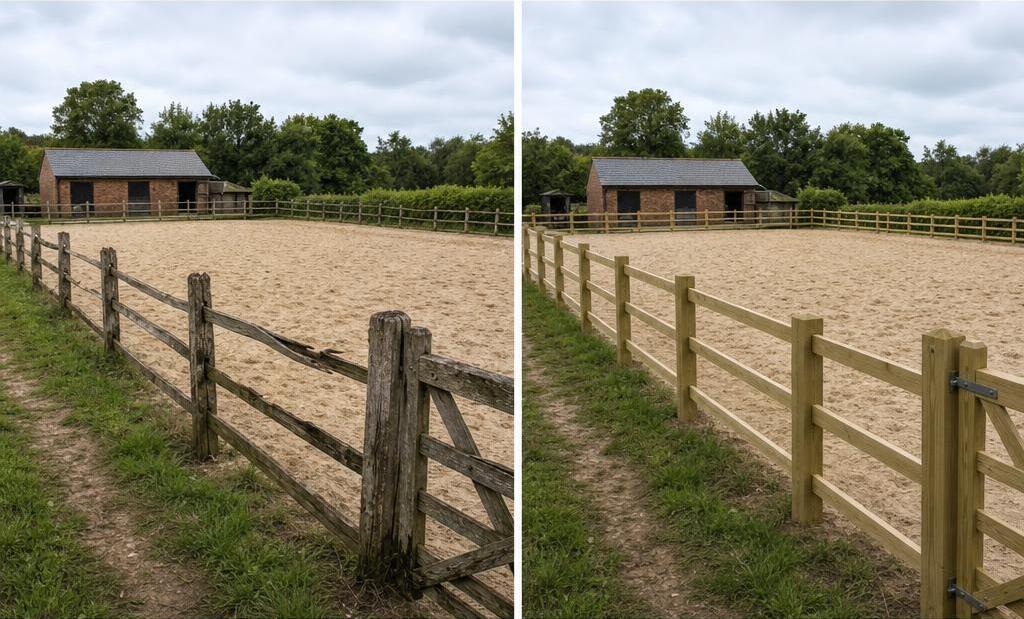
Before: rotten fencing

After: new fencing

Side-by-side illustration of a horse arena, with rotten timber fencing on the left and new post and rail fencing on the right

01Overview

How to think about it.

Horses lean, push, play and sometimes panic, so equestrian fencing is planned differently from general boundaries. Post and rail is the classic answer: visible, sturdy and good looking. The layout, rail spacing and finish all matter, and we talk them through with you rather than offering one-size answers.

02Types we offer

What each one is for.

Post and rail fencing

Timber posts with horizontal rails, in two, three or more rails depending on the design.

Suits
Paddocks, field boundaries, yard edges and the approach to a property.
Consider
More rails and closer spacing generally means more containment and visibility. Rail position and the number of rails depend on the horses and what needs to be kept in or out.

Arena fencing

Rails and posts surrounding a riding arena or school.

Suits
Outdoor arenas, schooling areas and round-pen style layouts.
Consider
Arena fences need to be stable, free of anything a horse or rider could catch on, and set to suit the surface and the way the arena is used. Gate position matters too.

Paddock layouts

Planning how fields are divided, where gates sit and how animals move between areas.

Suits
Rotating grazing, separating horses and keeping a clear route for feeding and turnout.
Consider
Corners, gateways and watering points are worth planning at the start. Wide enough gateways make daily work easier.

Gates and gateways

Gates sized and hung to suit horses, handlers and machinery.

Suits
Field entrances, yard gates and arena access.
Consider
Think about how you lead a horse through, and whether a vehicle or machine has to pass.

03Choosing well

Things worth deciding first.

Visibility and containment

A fence a horse can see clearly is safer for it. Rail height, spacing and the number of rails all play a part. Tell us about your horses and we will advise what to consider.

Horse needs

A foal, a stallion and a quiet pony do not all test a fence the same way. We cannot promise any fence is horse-proof, but a good layout and sound build reduce risks.

Rail spacing

Gaps between rails are part of the safety picture. We plan spacing with your animals in mind, so ask us what is worth thinking about.

Arena surrounds

Allow space around the arena, give thought to the entrance, and keep the inside face of the fence smooth.

Prices depend on the job, so none are listed here. Call or email with the details.

04 / How a job runs

  1. 1

    Look at the paddock or arena and talk about the horses and how it is used

  2. 2

    Set out the line, gateways and rail layout

  3. 3

    Posts set, rails fixed, gates hung

  4. 4

    Check the finished fence for anything that could catch or injure

05FAQ

Common questions.

How many rails do I need?

It depends on the horses, the height and what the fence has to contain. Two, three and more are all used. Describe your animals and we will talk through it.

Is post and rail safe for horses?

It is widely used for horses because it is visible and solid. No fence removes all risk, so layout, spacing and a clean build matter.

Can you build an arena fence?

Yes, arena fencing is part of what we offer. Share the size and the position and we can discuss the layout.

Can you combine post and rail with other fencing?

Yes. Some properties use post and rail at the front and stock netting on outer boundaries. We can plan both together.